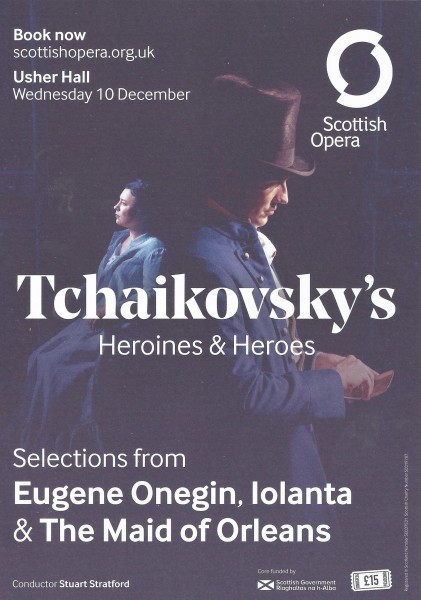
Tchaikovsky Heroines and Heroes 2025Scottish Opera
Read more about the opera General
Stuart Stratford trained at St Petersburg under the legendary teacher Ilya Musin.
Stratford's love of Russian music is well known, and it is perhaps surprising that he has conducted relatively little of this with Scottish Opera, at least in terms of full-scale stagings of Rimsky-Korsakov, Musorgsky or Shostakovich. Stratford has at least given us concert performances of the three Rachmaninov pieces, as well as Tchaikovsky's Iolanta.
The orchestra was on superb form, bringing out the fierily dramatic element in all three works. This was to be expected in the two extracts for Joan of Arc, perhaps less so for the extended scene from the equally underrated Iolanta.
Was it the inclusion of these two little known works that led to the disappointingly sparse audience? Or perhaps the absentees would have preferred a complete Onegin. Whatever the reason, the rows of empty seats were little reward for the concentrated work that must have gone into a one-off event. Perhaps the company can revive it in future for more grateful audiences.
This programme of excerpts turned out to be thoroughly enjoyable, even if the second half was a bit short of heroic characters. The company staged Eugene Onegin back in 2018, directed by Oliver Mears, who is now at Covent Garden - though it is hard to think of the title role as heroic.
Iolanta is a lovely opera, the composer's last, first played here by Opera North at the Edinburgh Festival in 1992. Since then it has been presented twice in concert versions, by the RSNO (beautifully conducted by Alexander Lazarev in 2004) and by Scottish Opera - Stuart Stratford led an excellent performance in 2017. Here we had one sequence, with Robert and his friend Vaudémont spying on Iolanta, Robert's departure, and the remaining pair discovering one another. It built up a surprising head of steam, with Lauren Fagan and Robert Lewis riding the orchestra beautifully.
The Maid of Orleans is even more of a rarity. The Bolshoi brought it to Glasgow during the 1990 Year of Culture. It was good to encounter it again, even in just two extracts. Joan of Arc is undoubtedly the heroine here. Perhaps the work is due for reconsideration. A new production in Amsterdam in November 2025 seems to have been received with enthusiasm. That is a co-production with the New York Met, so cinema-goers may with luck expect to see it in a year or two. In his brief talk after we had heard two excerpts, the conductor advised us that a projected Scottish Opera staging had been lost due to Covid, so there is still hope.
Joan's aria of farewell compares favourably with the equivalent provided by Verdi in Giovanna d'Arco, and Natalia Kutateladze was in lustrous voice. Her duet with Lionel reminded us of that Bolshoi cast and our first hearing of the late Vladimir Redkin, a wonderful baritone who sang several times in Scotland thereafter.
The second half gave us a sequence of highlights from Onegin, starting with the quartet of introduction, including a brief final word from the mezzo. We then had the letter scene followed by Lensky's aria and the duel. Daniel Barrett here made a huge impression in the usually marginal role of Lensky's second Zaretsky. After a beautifully played, though largely inessential, Polonaise. This thoroughly enjoyable evening of bleeding chunks ended with our anti-hero being given his largely deserved brush-off. All beautifully sung by Lauren Fagan, Robert Lewis and Josef Jeongmeen Ahn.
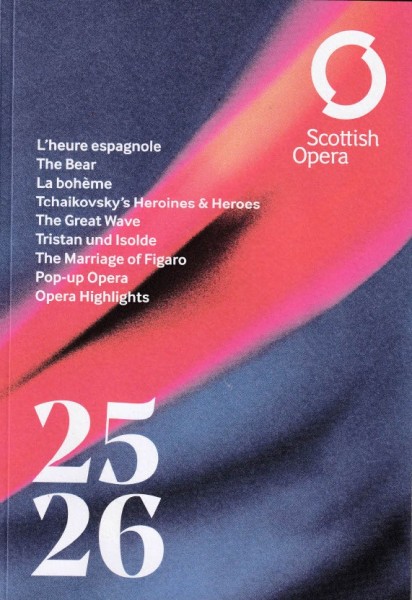
Scottish Opera's programme for 2025/26
The most obvious novelty is a world premiere with a uniquely Japanese theme. The Great Wave has music by Dai Fujikura and a text by Harry Ross with a central theme derived from the famous print by Hokusai.
The season opens with new productions of an interesting double bill of works by two great twentieth century masters, Maurice Ravel and William Walton. Scottish Opera did give us L'Heure espagnole as long ago as 1963, the company's second season, but Walton's operas, including his late comedy The Bear, have been conspicuous omissions.
As usual two popular favourites are given extended runs that include performances in Aberdeen and Inverness, as well as Glasgow and Edinburgh. The autumn revival is Renaud Doucet and André Barbe's thoroughly enjoyable staging of La bohème, first seen in 2017. The spring tour is one of the company's best productions, first seen in 2010 - Sir Thomas Allen's visionary interpretation of The Marriage of Figaro, which he is returning to work on.
There is a long-awaited return to the works of Wagner, with two concert performances of Tristan und Isolde, while a concert programme of excerpts this year is centred on Tchaikovsky.
The company's small-scale activities continue with autumn and spring tours of a Highlights programme. The Pop-Up Opera series also continues to spread the length and breadth of the country.